You’ve sharpened your craft scissors three times this month, yet they still crush paper edges instead of slicing cleanly. Meanwhile, your friend’s “expensive” Japanese scissors from 2019 still cut like new. The difference isn’t luck—it’s steel chemistry and hardness engineering that most brands hide behind vague “stainless steel” labels.
This guide decodes the technical specs that separate disposable scissors from lifetime tools, focusing on the exact steel grades and Rockwell hardness ranges that allow clean, repeatable sharpening without edge rollover or chipping.
Understanding the Hardness Sweet Spot
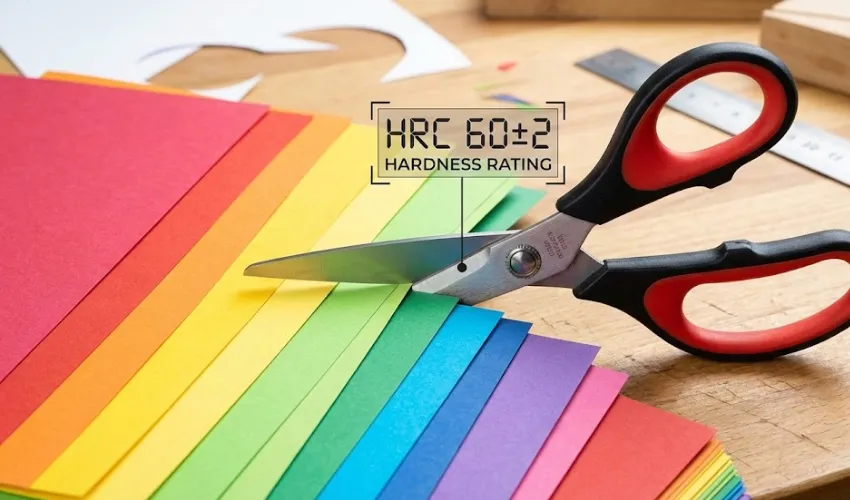
The 56–60 HRC Range Explained. Quality craft scissors operate in a narrow Rockwell hardness band between 56 and 60 HRC, balancing edge retention with practical sharpenability. Below 54 HRC, steel deforms under cutting pressure and dulls within weeks of fabric or cardstock use. Above 61 HRC, blades become brittle enough to chip on accidental wire contact or gritty cardboard.
Why This Range Matters for Home Users. Professional sharpeners can restore edges on ultra-hard steels, but home sharpening stones and pull-through devices require forgiveness. The 58–60 HRC zone allows hobbyists to maintain crisp edges using basic equipment without risking heat damage or uneven grinding that creates saw-tooth patterns.
Edge Retention vs. Maintenance Frequency. Scissors at 58 HRC typically need sharpening every 40–60 hours of mixed craft use (paper, fabric, thin plastic). Softer 54 HRC blades require touch-ups every 15–20 hours but never achieve the same slicing precision on layered materials.
Steel Grades That Actually Sharpen Cleanly
440C Stainless: The Industry Workhorse. This chromium-rich alloy reaches 58–60 HRC with proper heat treatment, offering corrosion resistance and consistent edge geometry. It responds well to ceramic and diamond sharpeners without leaving burrs, making it ideal for crafters who maintain their own tools.
VG10 and Japanese Upgrades. VG10-family steels use vanadium and cobalt additives to achieve fine grain structure at 58–62 HRC, supporting thinner, more acute edge angles. These steels excel at slicing delicate materials like tissue paper or silk but cost 40–70% more than 440C equivalents.
420J2: The Budget Trap. Often labeled simply as “stainless steel,” 420J2 alloys sit around 52–54 HRC for easy mass production. They sharpen effortlessly but lose their edge within days of cardstock cutting, creating a frustrating cycle of constant maintenance.
Steel Grade Transparency as Quality Signal. Manufacturers using premium steels advertise specific grades and hardness ranges on packaging. Absence of these specs usually indicates soft, generic alloys chosen for cost rather than performance.
Key Comparison: Steel Performance Metrics
| Steel Grade | Typical HRC | Edge Retention | Sharpening Difficulty | Best Use Case | Price Premium |
|---|---|---|---|---|---|
| 420J2 | 52–54 | Poor (15–20 hrs) | Very Easy | Light paper, entry-level | Baseline |
| 440C | 58–60 | Good (40–60 hrs) | Easy to Moderate | Multi-purpose crafting | +30–50% |
| VG10 | 58–62 | Excellent (60–90 hrs) | Moderate | Precision fabric/paper work | +50–80% |
| Ultra-Hard Alloys | 61–63 | Superior (90+ hrs) | Difficult | Professional studios only | +100–150% |
Reading This Table Strategically. The “Sharpening Difficulty” column matters more than edge retention for home crafters without specialized equipment. A VG10 scissors that requires professional sharpening every 18 months costs more over five years than 440C scissors maintained quarterly at home.
Design Features That Enable Long-Term Sharpening
Adjustable Screw Pivots vs. Fixed Rivets. Screw-tensioned scissors allow technicians to separate blades completely for full-length edge restoration, then reset cutting tension. Riveted designs force sharpeners to work around the pivot point, creating inconsistent edge geometry that leads to fabric snagging.
Micro-Serrations: Feature, Not Flaw. Lower-blade serrations on quality craft scissors grip slippery materials like laminated paper or synthetic fabrics. These are precision-milled patterns, not signs of poor steel—grinding them away during sharpening destroys the scissors’ functional design.
Ergonomic Handles Reduce Edge Damage. Cushioned grips prevent hand fatigue that causes users to over-force dull blades through materials. This misalignment bends cutting edges at a microscopic level, making subsequent sharpening require more aggressive material removal.
Eco-Impact: The True Cost of Disposable Steel
Lifecycle Carbon Footprint. Manufacturing one pair of quality 440C scissors generates roughly 0.8 kg CO₂e, but the tool lasts 10–15 years with proper maintenance. Disposable scissors at 0.4 kg CO₂e each become environmentally costlier after just two replacements.
Sharpening as Waste Reduction. Home sharpening using a ceramic rod or whetstone extends tool life indefinitely while consuming only water and minimal abrasive material. Professional sharpening services charge $8–15 per pair but eliminate the manufacturing and shipping emissions of replacement purchases.
Material Efficiency of Premium Alloys. VG10 and 440C steels contain recycled chromium and nickel, with most premium manufacturers using 40–60% post-industrial scrap content. Budget 420J2 scissors often use virgin ore due to lax quality control in low-cost supply chains.
Common Myths Debunked
Myth: “Hardest Steel Always Wins.” Scissors hardened beyond 61 HRC chip easily on abrasive materials like glitter cardstock or wire-edged ribbon. The brittleness that enables razor-thin edges becomes a liability in mixed-use craft environments where unexpected tough materials appear.
Myth: “All Stainless Steel Is Created Equal.” The “stainless steel” label spans hardness ranges from 48 HRC (cheaper than aluminum in edge retention) to 63 HRC (surgical scalpel territory). Without grade and hardness specs, you’re buying blind.
Myth: “Japanese Steel Justifies Any Price.” While VG10 outperforms 440C technically, the 50–80% price premium only benefits users cutting delicate fabrics daily. Weekend crafters see negligible practical difference between well-maintained 440C and VG10 scissors.
Budget Reality: Strategic Buying for Long-Term Value
The Two-Scissors Strategy. Invest in one pair of 440C or VG10 scissors (58–60 HRC) for fabric, paper crafts, and detail work. Pair this with a cheaper 420J2 scissors for abrasive tasks like cardboard boxes, plastic packaging, or wire cutting that would damage premium edges.
Price-Per-Year Calculation. A $45 VG10 scissors lasting 12 years with $15 annual sharpening costs $9.75/year. Five replacements of $12 disposable scissors over the same period cost $60 plus disposal impact. The premium tool becomes cheaper after year three.
Warning Signs of Overpriced Marketing. Some brands charge $80+ for 440C scissors by emphasizing hand-forging or exotic handle materials. Unless you need specialized ergonomics for medical reasons, these features don’t improve steel performance—you’re paying for aesthetics.
Conclusion
The Verdict on Quality Steel. For craft scissors that sharpen cleanly and last years, target 440C stainless steel at 58–60 HRC with adjustable screw pivots. This combination costs 30–50% more than disposable scissors but delivers 10x the service life through repeated clean sharpenings that maintain precise edge geometry.
The Action Step. Check current scissors for hardness ratings and steel grades—if the packaging or manufacturer website omits these specs, you’re likely holding soft alloy that will never hold a professional edge. Upgrade to one quality multi-purpose pair and watch your sharpening frequency drop by 60–70%.