The Truth About “Eco” Adhesives That Most Crafters Get Wrong
The Fear Is Real. You’ve read the eco-friendly label, seen the biodegradable claim, and still hesitated—because deep down, you’re worried that choosing green means choosing weak. Will your carefully assembled scrapbook pages peel apart in six months? Will that handmade card embarrass you before it even reaches the recipient?
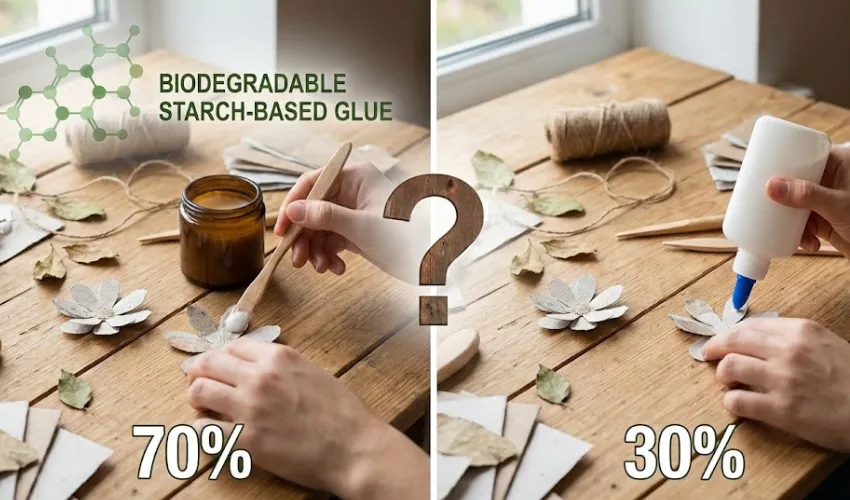
Here’s What You’ll Actually Learn. Biodegradable glues can absolutely hold up in craft projects, but only within a specific performance envelope. This guide cuts through the marketing haze to show you exactly when plant-based and protein adhesives deliver genuine strength, where they fall short, and how to match the right eco glue to your actual project demands—no greenwashing, no compromises that matter.
The Chemistry Behind Biodegradable Craft Adhesives
Starch and Dextrin Pastes Lead the Plant-Based Pack. Derived from corn, wheat, or potato starch, dextrin adhesives have anchored commercial paper packaging and laminating operations for decades. These pastes create surprisingly strong bonds on porous substrates—paper, cardboard, uncoated textiles—with dry bond strength and temperature stability that easily handle indoor craft conditions. The catch? Moisture is their kryptonite: bonds soften or fail when wet, and the organic base can support mold growth if stored improperly or exposed to damp environments.
Protein Glues Bring Old-School Strength to Modern Eco Crafts. Casein adhesives, milk-protein formulations with deep roots in traditional woodworking, have been re-engineered for contemporary use. Patent data confirms that modified casein systems deliver high tensile and peel forces when bonding canvas and heavy fabrics, specifically designed as environment-friendly alternatives without harsh chemical additives. Soy-based plant protein adhesives are emerging as formaldehyde-free wood and plywood binders, proving that renewable, lower-toxicity options can compete in demanding applications.
Cellulose and Polysaccharide Systems Fill the Middle Ground. Methylcellulose, plant gels, and bacterial nanocellulose (BNC) blends represent the cutting edge of sustainable binder research. Lab formulations combining aloe vera and BNC have demonstrated mechanical performance approaching commercial synthetic adhesives on cardboard substrates, though they typically still trail top-tier synthetic options in ultimate bond strength.
Water-Based PVA Occupies the “Eco-ish” Gray Zone. Polyvinyl acetate—the familiar white craft glue—is technically synthetic but water-dispersed and widely described as biodegradable compared to solvent-based systems. PVA generally outperforms starch adhesives in both bonding strength and water resistance, making it the pragmatic compromise when you need more durability than pure bio-based options provide but still want to avoid harsh chemical glues.
Key Takeaways: Performance Envelope vs. Traditional Craft Glues
| Adhesive Type | Best Substrates | Dry Bond Strength | Water Resistance | Shelf Life | Ideal Craft Uses |
|---|---|---|---|---|---|
| Starch/Dextrin Paste | Paper, cardboard, light textiles | Good (suitable for envelopes, cartons, laminating) | Poor (softens when wet) | Limited (6-12 months) | Scrapbooking, papercrafts, kids’ projects, origami |
| Casein (Protein) | Canvas, fabric, porous wood | High (comparable to some wood glues) | Moderate | Moderate (12-18 months) | Fabric collage, canvas mounting, bookbinding |
| Cellulose/Plant Gels | Paper, cardboard, light assembly | Moderate to good | Poor to moderate | Moderate | General papercraft, card making, lightweight decor |
| Eco-Labeled PVA | Paper, wood, some plastics | High (industry standard for crafts) | Good | Long (2+ years) | Mixed-media projects, wood assembly, heavy-duty papercrafts |
Starch Formulations Handle Real-World Craft Demands. The fact that dextrin and starch adhesives secure commercial packaging—cartons, envelopes, laminated materials—proves they deliver bond strength well beyond casual hobby requirements on similar substrates. Industrial and lab data confirm that optimized bio-based formulations can approach synthetic adhesive performance in packaging applications, though full parity remains application-dependent.
The PVA Comparison Reveals the Trade-Off. Starch-based adhesives are generally weaker and less water-resistant than PVA, which explains why polyvinyl acetate dominates general-purpose craft and wood glue markets. However, for purely indoor craft usage with minimal water exposure, this strength difference becomes irrelevant if joints are properly sized and not heavily stressed. Your scrapbook pages don’t need epoxy-level bonding—they need appropriate bonding for their actual use case.
Structural Loads and Outdoor Exposure Remain Deal-Breakers. Biodegradable glues are not 1:1 replacements for waterproof PVA, epoxy, or cyanoacrylate in demanding applications. Heavy shelf brackets, outdoor garden art, and moisture-exposed projects still require synthetic adhesives. The “envelope” of reliable performance for bio-based glues encompasses indoor, low-moisture, porous-substrate crafts—which happens to cover 80% of hobby crafting.
Safety and Indoor Air Quality: Separating Marketing from Reality
Low-VOC Performance Makes Bio-Glues Genuinely Kid-Friendly. Water-based biodegradable adhesives—starch, dextrin, casein, cellulose formulations—are typically free from organic solvents, which is precisely why they’re promoted as environmentally friendly and suitable for health-sensitive users. Safety data sheets for mainstream water-based craft glues often classify them as “not hazardous” under EU CLP regulations, with the primary concern being preservatives like isothiazolinones that can trigger skin allergies in sensitive individuals.
The Allergen Myth Needs Correction. “Natural” or “non-toxic” does not automatically mean allergen-free or universally harmless. Some bio-based components—milk proteins in casein, cereal-derived starches—may be problematic for very sensitive people. Even non-hazardous craft glues note isothiazolinone preservatives as potential skin sensitizers in their safety documentation. Eco-friendly and bio-based do not equal hypoallergenic; users with severe allergies must check labels and safety data sheets for specific ingredients and preservatives.
Food-Contact Standards Offer the Highest Safety Benchmark. Starch, dextrin, and plant-resin glues are explicitly positioned as both biodegradable and non-toxic in eco-oriented adhesive guides, especially when formulated to food-contact standards for packaging applications. This makes them particularly attractive for projects involving children or food-adjacent contexts, where residual chemical exposure is a legitimate concern.
Busting the Myths That Keep Crafters from Going Green
Myth 1: “Biodegradable Glue Falls Apart Quickly.” Biodegradability describes end-of-life behavior in soil or compost conditions, not immediate failure on your craft table. Dextrin and starch adhesives securely hold cartons, envelopes, and laminates for the full service life of commercial products, yet still break down more readily in the environment than synthetic resins. Your paper flowers won’t spontaneously decompose on display—they’ll last for years indoors, then return to earth at end-of-life instead of persisting for centuries.
Myth 2: “All Biodegradable Glues Are Inherently Weak.” Modified casein and plant-protein adhesives have been engineered to reach high tensile and peel strengths in woodworking and plywood applications, directly competing with formaldehyde-based resins in some use cases. Research formulations combining bacterial nanocellulose and aloe vera have demonstrated mechanical performance “comparable to commercial synthetic adhesives” for specific packaging substrates. The weakness isn’t in the bio-based chemistry itself—it’s in poorly formulated products trading on eco-marketing without proper engineering.
Myth 3: “Natural Always Means Safe and Non-Toxic.” This dangerous oversimplification ignores preservatives, processing chemicals, and natural allergens. Safety data for “non-hazardous” craft glues still warn about sensitizing preservatives, and some users react to natural proteins or starches. Always review ingredient lists and safety documentation, especially for children’s projects or users with known sensitivities.
The Expert Filter: How to Spot Actually Reliable Bio-Based Glues
Industrial Application History Beats Marketing Every Time. The real reliability test for a “biodegradable” craft glue isn’t the eco label—it’s whether the adhesive is specified for commercial laminating, carton sealing, or envelope production. Plant- or protein-based adhesives engineered to withstand real-world handling stresses in packaging operations are already proven to exceed hobby craft requirements on porous materials. This makes them far more trustworthy choices for serious papercraft and cardboard builds than generic “green” glues with vague sustainability claims.
Check for Substrate-Specific Ratings, Not Just “Eco” Badges. Packaging-grade starch adhesives carry explicit ratings for porous substrates, moisture exposure limits, and temperature ranges. These specifications translate directly to craft performance: if a dextrin paste can secure a shipping carton through handling and storage, it will absolutely hold your handmade journal binding or scrapbook page assembly.
Match Chemistry to Craft Conditions, Not Idealism. Use starch/dextrin/casein formulations for low-load, dry, paper/textile projects where they excel. Deploy water-based PVA as a pragmatic “greenish” compromise when you need stronger bonding, better water resistance, or longer working time. Reserve synthetic adhesives (epoxy, cyanoacrylate, waterproof PVA) for structural loads, outdoor exposure, and non-porous materials where bio-based options genuinely cannot perform.
Budget Reality: Green Doesn’t Always Mean Expensive
Bulk Starch Pastes Offer Exceptional Value. Commercial-grade dextrin and wheat paste concentrates cost significantly less per ounce than branded craft glues when purchased in bulk from art supply or bookbinding sources. Mix-your-own powder formulations drop the price even further while reducing packaging waste—a genuine win for both budget and environmental impact.
Mid-Tier Protein Glues Split the Difference. Modified casein adhesives typically fall between budget starch pastes and premium synthetic glues in price, offering a reasonable middle path when you need stronger bonding for fabric or canvas projects without jumping to full synthetic chemistry.
PVA Remains the Most Cost-Effective High-Performance Option. Water-based polyvinyl acetate glues deliver the best strength-per-dollar ratio for general crafting, which explains their market dominance. Eco-labeled PVA formulations add a modest 10-20% price premium over generic white glues while providing measurably better environmental profiles than solvent-based alternatives.
Your Verdict: When Biodegradable Glues Deliver Real Performance
For Indoor, Porous-Substrate Crafts, Bio-Based Adhesives Are Genuinely Reliable. Paper projects, cardboard construction, scrapbooking, origami, fabric collage, canvas mounting, and lightweight home decor fall comfortably within the proven performance envelope of starch, dextrin, and casein formulations. These adhesives will not fail you if you respect their moisture limitations and match chemistry to application.
The Water and Load Boundaries Are Non-Negotiable. Bathroom decor, outdoor projects, structural assemblies under continuous stress, and anything exposed to regular moisture require synthetic adhesives. Biodegradable glues are not universal replacements—they’re purpose-built tools for a large subset of craft applications.
Choosing “Green” No Longer Means Accepting Inferior Results. The gap between optimized bio-based adhesives and synthetic craft glues has narrowed dramatically in recent years. For the vast majority of hobby and art projects, properly selected biodegradable formulations deliver performance that is functionally indistinguishable from conventional options while offering genuine environmental and health advantages.
Still curious about putting these principles into practice? Check our Eco-Friendly Crafts section for step-by-step projects using biodegradable adhesives, from zero-waste gift wrapping to upcycled cardboard furniture that proves green crafting can be both strong and sustainable.