You love the wild, lush look of a meadow centerpiece. But one glance at your apartment dining table and the dream feels impossible. Here’s the truth: a small table isn’t a limitation. It’s a design constraint that makes your arrangement smarter.
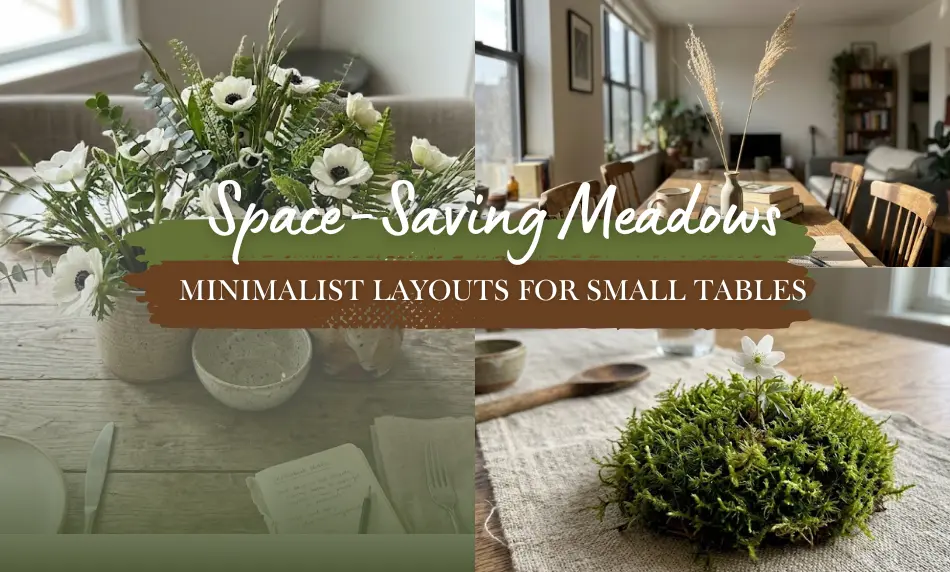
These five layouts are built specifically for urban hosts, intimate dinners, and micro-weddings where every inch of surface area counts. You’ll get the meadow feeling without losing space for a single water glass.
The Ground Rules Before You Arrange Anything
Before you place one stem, set your plates. This is the single most important step for small-table success.
A real homeowner on HomeDecorating learned this the hard way: “I tried a ‘meadow’ on a standard 4-person IKEA table. My advice: Set the plates FIRST. If you design the flowers on an empty table, you’ll realize too late that your guests can’t actually fit their water glasses or elbows.”
Follow the Golden Ratio of table decor: your flowers and decor should occupy no more than 30% of the total surface area. Everything else is breathing room for your guests.
The Cluster Island Strategy
This is the foundational layout for round and square tables under 48 inches. Instead of running one long centerpiece, you break the meadow into 3 to 4 distinct “islands.”
The reason it works is counterintuitive. On a small or round table, a continuous line of flowers acts like a wall. Breaking it into clusters creates negative space, and that openness actually makes the table feel larger.
How to Build a Cluster Island
Start by grouping three vessels of different heights into one tight cluster: one focal vessel (the tallest), one filler vessel (mid-height), and one architectural vessel (low and wide). Leave at least 5 inches of clear space between each cluster for glassware and shared plates.
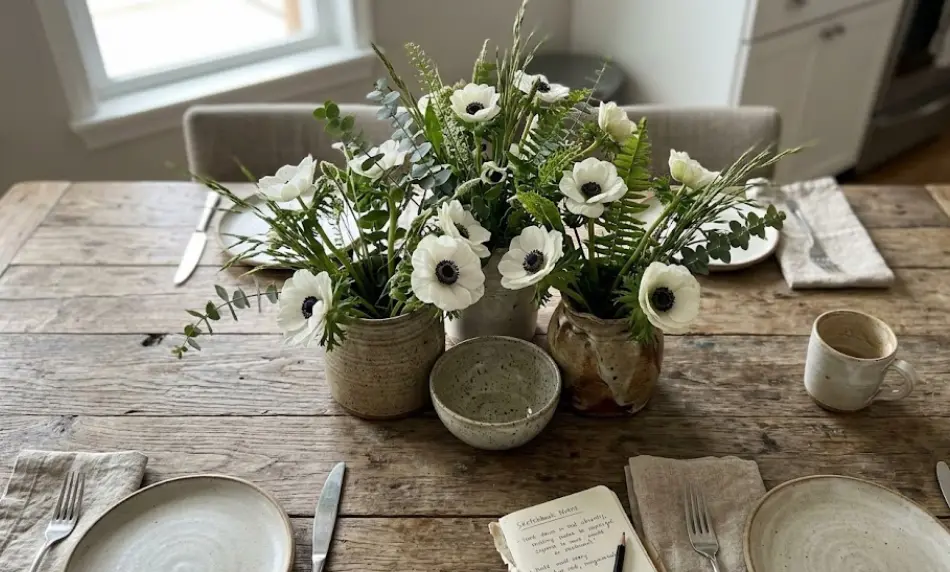
Use 3-inch shallow ceramic bowls or heavy glass ramekins as your vessels. Each cluster costs $10 to $15 to build using supermarket flower bundles.
Verticality Without the Bulk
Small tables lack width, so the solution is to build upward, not outward. The trick is choosing stems that are tall but visually “airy” so they don’t block conversation across the table.
This is where flower selection becomes your superpower.
Choosing the Right See-Through Stems
Use flowers with thin, open profiles: Scabiosa, Cosmos, or Bleached Ruscus. These reach 12 to 18 inches tall but are so delicate that your dinner guest is perfectly framed through them, not hidden behind them.
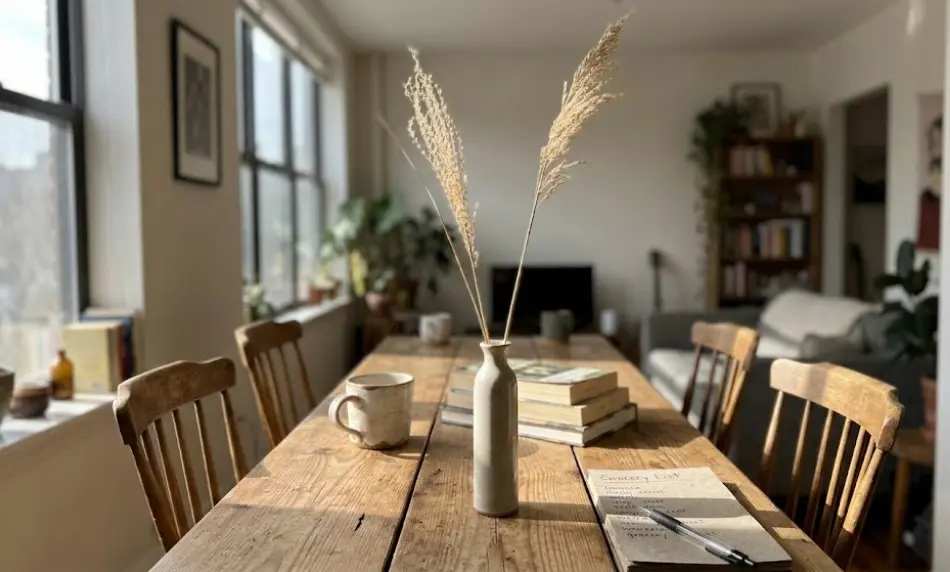
Keep your focal blooms either below 8 inches or above 20 inches. The range between 8 and 20 inches is what designers call the “Conversation Zone” and placing anything there forces guests to look around your arrangement all evening. Other great stem choices include Allium, Oncidium Orchids, and Butterfly Ranunculus.
The Linear Creep for Narrow Rectangles
If your table is a long, narrow rectangle (think apartment nook tables or console tables converted for dining), this layout turns that challenge into a feature. You follow the long axis of the table with a staggered line of tiny bud vases, keeping the total width to just 4 to 5 inches.
The visual effect is of a single, connected meadow growing down the center of the table, even though it’s made of completely separate pieces.
Building the Zigzag Bud Vase Runner
Arrange 5 to 7 mismatched clear bud vases in a loose zigzag pattern down the center of the table. Connect them visually by weaving loose strands of Smilax or Ivy between the bases.
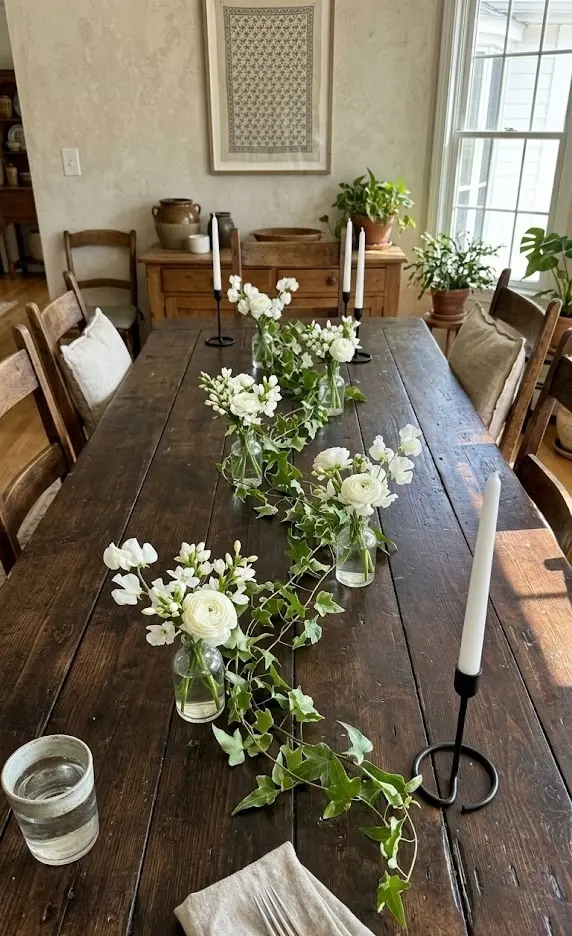
This entire layout requires only 4 inches of central table width. Your materials list is simple: 5 to 7 mismatched clear bud vases and one bunch of Italian Ruscus for the connective greenery.
The Low-Profile Moss Ground
Sometimes the best centerpiece is one that never competes with the view at all. The Moss Ground layout sits completely below the plate line, creating a forest-floor vibe that feels lush and intentional without adding a single inch of visual height.
This is the right choice for candlelit dinners, low-ceiling rooms, or any setting where you want drama through texture rather than height.
Setting Up a Moss Mound
Lay a waterproof runner down the center of your table first. Place flat pillows of Mood Moss or Sheet Moss directly onto the runner, then tuck small bloom tubes (water picks) into the moss to hold 2 to 3 focal flowers per mound.
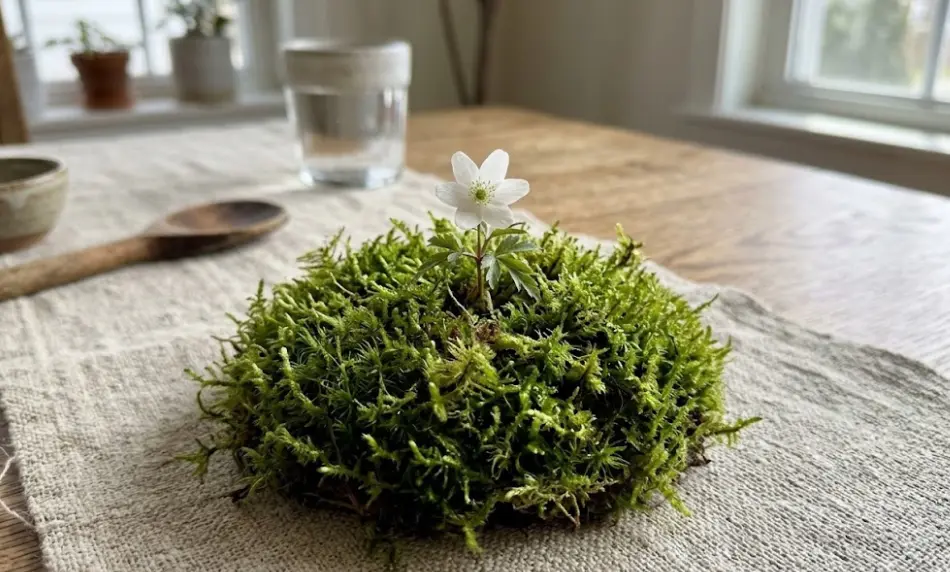
Water picks cost about $5 for a pack of 20, and a bag of preserved or live moss runs around $15. Real Mood Moss can be misted and reused for up to two weeks if you keep it out of direct sunlight.
The Pocket Meadow Favor
For intimate dinners with close friends, your centerpiece can do double duty. The Pocket Meadow is a tiny arrangement built to live at each place setting and travel home in a guest’s hand at the end of the night.
It’s a centerpiece and a party favor at once, which makes it a smart spend for small-scale events.
Building the Espresso Cup Favor
Use a miniature 1-inch Kenzan (a small floral pin frog) placed inside a tiny espresso cup as your base. Arrange a small cluster of stems directly into the Kenzan.
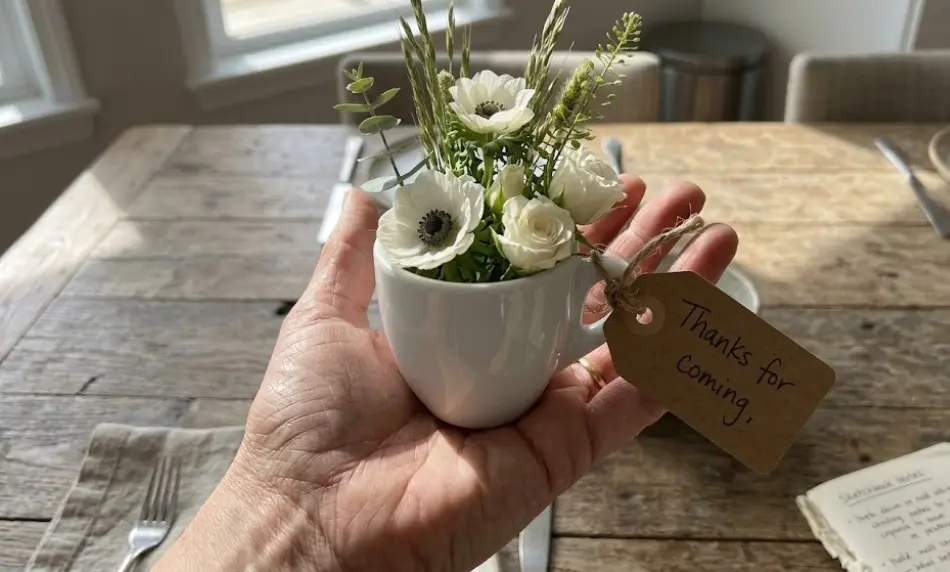
Keep the finished favor no larger than 4 by 4 inches so it fits comfortably in a tote bag or purse. Tie a small “Thanks for coming” tag to the handle of the cup to complete the look.
Quick-Reference: Which Layout Fits Your Table?
Match your table shape and size to the right layout before you buy a single stem.
Round tables under 48 inches: use the Cluster Island Strategy and aim for 3 islands with 5 inches of clearance between each.
Narrow rectangular tables: use the Linear Creep with a zigzag bud vase runner no wider than 4 to 5 inches down the center.
Any table where sightlines matter: pair the Vertical Stem lift with your chosen base layout.
Low-ceiling or candlelit settings: choose the Moss Ground to keep everything below the plate line.
Intimate dinners with 6 guests or fewer: build Pocket Meadow favors at each place setting and skip a traditional centerpiece entirely.
One Last Rule to Remember
Design your arrangement on a set table, not an empty one. Place your plates, lay your silverware, set your glassware, and then fill the remaining space with flowers. Your meadow should feel like it grew up around your guests, not like your guests are working around the flowers.
That single habit will make every layout on this list work better, every single time.