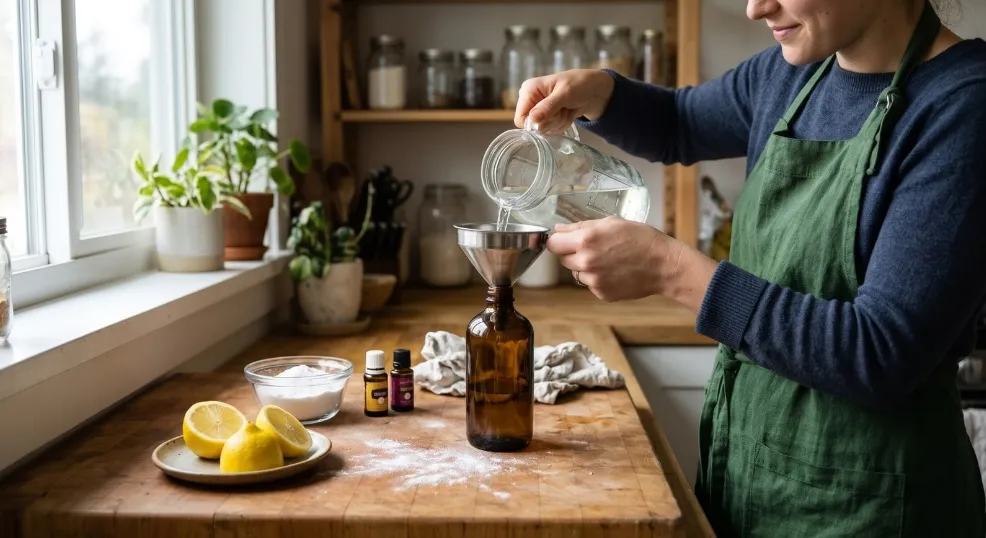
Ever find yourself in the cleaning aisle, squinting at a bottle full of ingredients you cannot pronounce? Creating your own homemade cleaning supplies is a wallet-friendly approach that puts you back in control of your family’s health. Our grandparents kept their homes sparkling with vinegar and baking soda, proving you never needed all those harsh chemicals in the first place.
Why You Should Switch to Homemade Cleaning Supplies
Making the switch to chemical-free cleaners transforms your space into a safe haven while keeping extra cash in your pocket.
Improve Your Indoor Air Quality
Commercial products often contain volatile organic compounds (VOCs) and synthetic fragrances. These hidden additives can trigger allergies and skin sensitivities over time. With non-toxic cleaning supplies, you know exactly what is in each bottle you use around your home.
Keep More Cash in Your Pocket
You can make an effective all-purpose cleaner for mere pennies. A 1-gallon (3.78 liters) jug of white vinegar costs a few dollars and can make dozens of cleaning solutions. Compare that to spending $5 to $8 (USD) per bottle on commercial cleaners at the big box store.
Protect the Environment
Every plastic bottle we do not buy is one less piece of waste sitting in our landfills. By making eco-friendly cleaning products, you are actively reducing packaging waste. You are also eliminating harmful chemical runoff into local water systems.
Essential Ingredients for Your DIY Cleaning Arsenal
Think of these as your cleaning toolkit foundation. Once you stock these basic pantry staples, you will be ready for any cleaning challenge your house throws at you.
White Vinegar and Baking Soda
Vinegar cuts through grease, dissolves mineral deposits, and neutralizes odors beautifully. The pungent vinegar smell dissipates quickly as it dries. Baking soda is a mild alkaline powder that acts as a gentle abrasive and deodorizer.
Castile Soap and Hydrogen Peroxide
Biodegradable castile soap, like Dr. Bronner’s, provides serious cleaning power for your thrift flips without synthetic detergents. A few drops go a long way in cutting through stubborn dirt. Hydrogen peroxide serves as an excellent natural bleaching agent.
Essential Oils and Supporting Players
Tea tree oil acts as a natural disinfectant, while lemon oil cuts right through household grease. You should also keep washing soda for heavy-duty cleaning and lemon juice on hand. Vodka or rubbing alcohol are fantastic additions for sanitizing surfaces and achieving streak-free glass.
17 Natural DIY Cleaning Recipes for Every Room
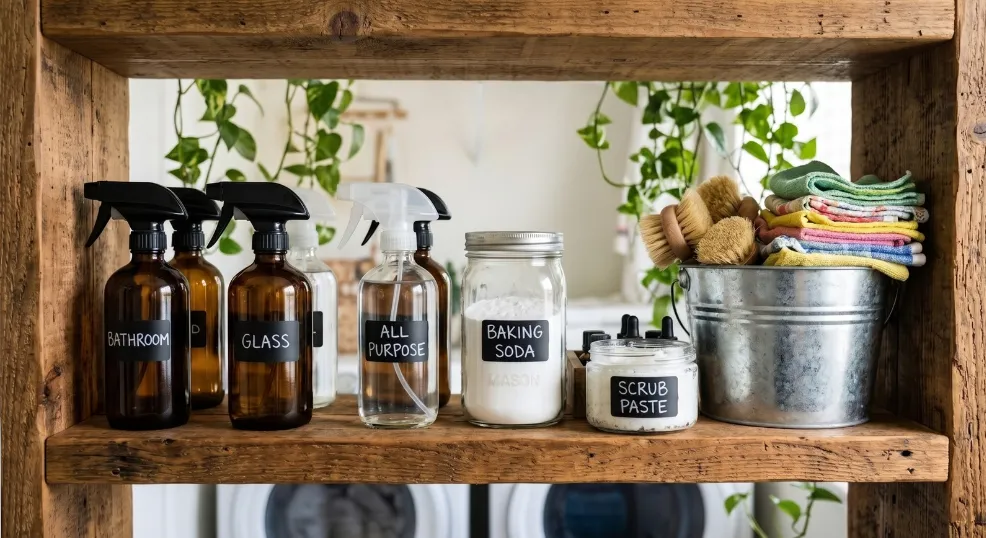
Grab some repurposed glass spray bottles and let us get mixing. These workhorse formulas handle most of your daily homeownership tasks with absolute ease.
1. Homemade All-Purpose Cleaner
Mix 1 cup (240 ml) of white vinegar with 1 cup (240 ml) of water in a spray bottle. Add 10 to 15 drops of essential oil like lemon, lavender, or tea tree, and shake before each use. For a calming variation, swirl 20 drops of lavender essential oil and 1 teaspoon (5 ml) of liquid castile soap into the mix.
2. Homemade Disinfectant Cleaner
Combine 1 cup (240 ml) of water with 1/4 cup (60 ml) of vodka or rubbing alcohol in a spray bottle. Drop in 20 drops of tea tree oil and 10 drops of eucalyptus oil for their natural purifying properties. Spray this generously on high-touch surfaces like doorknobs and let it sit for 5 to 10 minutes.
3. Homemade Glass Cleaner
Pour 2 cups (470 ml) of water, 2 tablespoons (30 ml) of white vinegar, and 2 tablespoons (30 ml) of rubbing alcohol into a bottle to mix your own homemade glass cleaner. Add 3 drops of your favorite essential oil to mask the alcohol smell. Upcycle old newspapers or use a washable microfiber cloth for the best lint-free results.
4. DIY Bathroom Tub and Tile Spray
Mix 1 cup (240 ml) of white vinegar, 1/2 cup (120 ml) of hydrogen peroxide, and 1 tablespoon (15 ml) of dish soap. Add 10 drops of peppermint oil for a fresh aroma. Spray this directly onto shower walls and bathtubs, letting it sit to lift the grime before scrubbing.
5. Fizzy Toilet Bowl Cleaner
Sprinkle 1 cup (240 grams) of baking soda directly around the inside of the toilet bowl. Follow this by spraying a mixture of 1/2 cup (120 ml) of white vinegar and 10 drops of tea tree oil over the powder. Allow the chemical reaction to fizz for 10 to 15 minutes before giving it a quick scrub.
6. Baking Soda Soft Scrub Paste
Mix baking soda with just enough water to form a thick paste. Add a few drops of liquid castile soap for extra grease-cutting power against stuck-on messes. Apply this paste to a damp cloth and work it in circular motions over baked-on food or soap scum.
7. Natural Drain Cleaner
Pour 1/2 cup (120 grams) of baking soda directly down your slow-moving drain. Follow it immediately with 1/2 cup (120 ml) of white vinegar and cover the drain opening with a rag. Let the mixture fizz in the pipes for 15 minutes, then flush the system with boiling hot water.
8. Homemade Scouring Powder
Combine 1 cup (240 grams) of baking soda, 1/2 cup (120 grams) of washing soda, and 1/2 cup (120 grams) of borax. Stir in 20 drops of your preferred essential oil and store the dry mixture in an upcycled parmesan cheese shaker. Sprinkle it on wet surfaces, scrub vigorously, and rinse thoroughly.
9. DIY Powder Laundry Detergent
Mix 2 cups (470 grams) of washing soda with 2 cups (470 grams) of borax in a large bowl. Grate one 5-ounce (140 gram) bar of castile soap using a standard cheese grater and add it to the mix alongside 20 drops of essential oil. Store the powder in an airtight glass jar and use 1 to 2 tablespoons (15 to 30 ml) per load.
10. DIY Liquid Laundry Detergent
Dissolve the dry powder formula mentioned above into 2 gallons (7.5 liters) of hot water. Stir the mixture continuously until the grated soap and powders are completely dissolved. Allow the liquid to cool before transferring it to heavy-duty jugs, using 1/4 cup (60 ml) per standard wash load.
11. Homemade DIY Stain Remover
Combine 1 cup (240 ml) of water, 1/4 cup (60 ml) of hydrogen peroxide, 1/4 cup (60 ml) of dish soap, and 2 tablespoons (30 grams) of baking soda. Store the solution in a dark, opaque spray bottle because hydrogen peroxide breaks down quickly in light. Spray directly on stains, let it sit for 10 to 15 minutes, and then launder as usual.
12. Simple Vinegar Cleaning Spray
Create a standard spray by mixing equal parts water and white vinegar in a spray bottle. You can elevate this by steeping leftover orange or lemon peels in a jar of vinegar for two weeks. Strain out the peels and dilute the infused vinegar with equal parts water for a fresh-scented cleaner.
13. Olive Oil Furniture Polish
Combine 1/4 cup (60 ml) of olive oil, 1/4 cup (60 ml) of white vinegar, and 10 drops of lemon essential oil. Shake the bottle well before each use as the oil and vinegar will separate. Apply a small amount to a soft flannel cloth and buff it gently into your wood grain.
14. DIY Reusable Cleaning Wipes
Cut old towels or scrap flannel into small squares for a great scrap-busting project. Mix 2 cups (470 ml) of water, 2 tablespoons (30 ml) of castile soap, and 10 drops of essential oil. Place your cloth squares into an airtight container, pour the liquid over them, and toss them in the laundry after use.
15. Fruit and Vegetable Wash DIY
Combine 1 cup (240 ml) of water, 1 cup (240 ml) of white vinegar, 1 tablespoon (15 ml) of lemon juice, and 1 tablespoon (15 grams) of baking soda. Mix gently in a spray bottle as the baking soda will cause it to fizz. Spritz your produce generously, let it sit for 5 minutes, and rinse everything thoroughly with cold water.
16. Lemon Juice Cleaner
Use fresh lemon juice to naturally remove rust stains from fabric or dissolve tough mineral deposits around faucets. Brighten white clothes by adding 1/2 cup (120 ml) directly to your wash cycle. It also safely cleans and deodorizes wooden cutting boards.
17. Soap Nuts Cleaner
Soap nuts are dried berries that contain natural cleaning agents called saponins. Place 4 to 5 soap nuts into a small muslin cloth bag and toss it directly into your washing machine drum. These zero-waste nuts will last for 4 to 5 loads before they need to be composted.
The Science of Natural Disinfectants
Natural alternatives can be highly effective at keeping your home sanitary when you use the right ingredients properly. Studies show white vinegar can reduce bacteria by up to 90% on certain surfaces, particularly against E. coli and Salmonella. At a 3% concentration, hydrogen peroxide effectively kills bacteria, viruses, and fungi.
How to Maximize Disinfecting Power
The secret is exactly how you use your ingredients. Always clean first to remove visible dirt before you attempt to disinfect. Let your solutions sit on surfaces for 5 to 10 minutes before wiping to allow proper contact time.
Storage and Safety Guidelines
Making cleaners is one thing, but storing them safely ensures your supplies remain effective and safe for your family.
Container Choices
Glass spray bottles are best because they do not react with acids like vinegar. Dark amber or cobalt blue glass protects essential oils and hydrogen peroxide from light degradation. Always label your cleaners with the contents and the date they were made.
What Never to Mix
Never mix vinegar and hydrogen peroxide in the same bottle. Avoid mixing vinegar and castile soap, as it creates an ineffective gunk. Most importantly, avoid any combination with bleach because it creates toxic fumes.
Surface Compatibility
You need to match your cleaner to your material to guarantee proper surface safety. Avoid using vinegar on natural stone like marble or granite. You should also keep acidic cleaners away from your delicate hardwood floors.
Read Next: Homemade Cleaner Safety Guide for Pets & Surfaces
Your Journey to a Cleaner, Greener Home
Transitioning away from chemical-heavy cleaning products does not have to happen overnight. Every commercial cleaner you replace with a DIY alternative is a massive win for your health, your wallet, and the environment. Start by mixing up just one or two of these recipes, like the all-purpose spray or the reusable wipes. Upcycle an old cotton t-shirt into reusable cleaning rags to stretch your budget even further as you build your naturally clean home.