
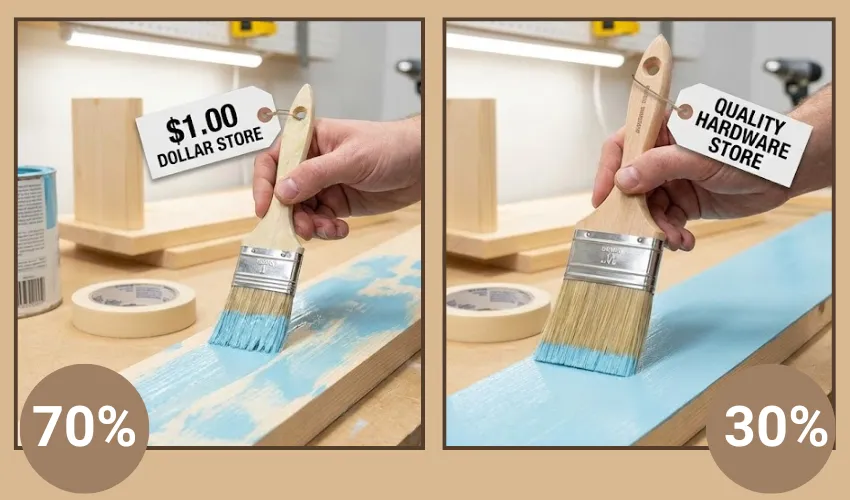
The Problem. You’re standing in the paint aisle, staring at a 99-cent brush pack and a $12 Purdy angled sash brush, wondering if you’re about to waste money on marketing hype or sabotage your entire weekend project with cheap bristles that shed into your freshly painted trim.
The Promise. This guide cuts through the confusion with hard data on durability, finish quality, and real-world cost-per-project so you can choose the right brush for every job—from messy epoxy work where cheap makes sense to interior walls where quality pays off immediately.
When Dollar Store Brushes Actually Win
Sacrificial Tool Duty. Dollar store chip brushes excel at one-off jobs where the brush becomes a casualty—think contact cement, polyurethane glue, or tar-based sealers that chemically attack even premium bristles.
Craft Projects with Low Stakes. For kids’ base-coating, texture effects on theater props, or rough sealing work where a few stray bristles won’t matter, the ultra-low price point (often under $1 per brush or in multi-packs) makes perfect sense.
Intentional Disposal Jobs. Some resin and solvent-heavy applications are designed around single-use brushes because even quality bristles can be permanently damaged—here, cheap tools eliminate the guilt of tossing them.
The Hidden Costs Beginners Miss
Time Theft in Disguise. Cheap filaments hold significantly less paint per load, forcing you to reload constantly and repaint streaky sections multiple times—what looks like a $5 savings on brushes often costs you 2-3 extra hours on a single room.
The Disposable Trap. Because dollar store brushes aren’t worth cleaning (loose ferrules, bristle loss, and wobble appear after one use), most people throw them away, accumulating more plastic waste and often spending more annually than buying one reusable quality brush.
Wrong Bristle Syndrome. Many beginners grab “nice-looking” natural bristle brushes at hardware stores, then use them with latex paint—the hollow hairs absorb water, swell, and go limp, destroying your edge control and defeating the entire purpose of upgrading.
The Performance Matrix: What Actually Matters
| Factor | Dollar Store Brushes | Hardware Store Brands (Wooster, Purdy, Hamilton) |
|---|---|---|
| Upfront Cost | Ultra-low: $1 or less per brush, cheap multi-packs | $3–$20+ depending on size and line |
| Durability | Short life: loose ferrules and bristle loss appear quickly, rarely worth cleaning | Multi-project or multi-year lifespan with epoxy-set bristles and strong ferrules |
| Finish Quality | Stiffer filaments with rough-cut tips leave visible streaks and brush marks | Tapered, flagged bristles hold more paint and create smoother, even films |
| Bristle Shedding | High risk: often need pre-combing to remove loose hairs before painting | Good lines advertise zero bristle loss with epoxy ferrules and quality plugs |
| Coverage Speed | Slower: less paint capacity means constant reloading and lap marks | Faster: higher paint retention reduces trips to the can |
| Eco-Impact | High waste-per-project ratio due to disposable lifespan | Better material efficiency: fewer tools to landfill over time |
When Quality Brushes Pay for Themselves Immediately
Interior Walls and Trim Work. Higher-quality angled synthetics hold significantly more paint, cut sharper lines around outlets and corners, and eliminate the roller-like texture that cheap brushes leave on doors and casing.
Water-Based Paint Optimization. Modern synthetic bristles (nylon/polyester blends) are engineered specifically for latex and acrylic—they resist water absorption, maintain stiffness, and won’t swell or flare like natural bristles do.
The Reusable Shop Standard. For anyone painting more than once annually, a small core set (one 2–2.5″ angled sash brush plus one 1–1.5″ detail brush) quickly pays for itself through speed gains and the ability to clean and reuse across dozens of projects.
Furniture and Sellable Crafts. Any decorative finish that customers or guests will inspect up close—painted furniture, wall art, handmade gifts—demands the streak-free, bristle-free finish that only quality tools can deliver consistently.
Budget Reality Check: Short-Term vs. Long-Term
Short-Term Budget Winner. If your use case is genuinely one-off or highly destructive (epoxy application, messy kids’ craft party, gritty masonry coatings), dollar store chip brushes deliver the lowest cash outlay with zero guilt about disposal.
Long-Term Value Champion. For any repeating context—home repairs, furniture refinishing, seasonal room updates—hardware store synthetics win decisively on total cost-per-square-foot painted because they survive cleaning and reuse across 10+ projects while maintaining finish quality.
The Honest Eco Math. Treating cheap brushes as sacrificial tools for glue and resin work, while investing in a small core set of quality synthetics for all actual paint applications, minimizes both your lifetime tool cost and your plastic waste footprint.
The Quality Tells You Need to Know
Synthetic Bristle Specification. Look for explicit “nylon/polyester blend” labeling on packaging—this immediately separates true latex-optimized brushes from generic bristle bundles that may be natural hair or low-grade synthetic.
Epoxy-Set Construction. This term means bristles are permanently bonded into the ferrule with industrial epoxy rather than simple compression—it’s the single biggest predictor of zero bristle loss and multi-year durability.
No Bristle Loss Claims. When manufacturers explicitly guarantee zero shedding, they’re confident enough in their ferrule construction and quality control to stake their reputation on it—this is your green light for finish-critical work.
Conclusion
The Verdict. Dollar store paintbrushes aren’t universally bad—they’re correctly specified for sacrificial duty on glue, epoxy, and messy crafts where disposal is planned. But for any paint job where finish quality, time efficiency, or tool longevity matters (walls, trim, furniture, decorative projects), hardware store synthetics deliver superior results and lower total cost through reusability. The smartest approach: keep cheap chip brushes for destructive tasks, and invest in 2-3 quality synthetic brushes for all serious painting.
Ready to put these tools to work? Check our Budget-Friendly Craft Tools category for project ideas that maximize your brush investment, or explore Eco-Friendly Craft Supplies to find paint and finish options that pair perfectly with reusable, long-life tools.