You fell in love with that chunky jute rug online, convinced it was the eco-friendly choice for your living room. Then you scroll through the reviews and find horror stories about mold blooms, mystery odors, and allergy flare-ups. The marketing says natural equals safe, but botanical reality often tells a completely different story.
The Hidden Catch Behind Natural Fibers
Plant fibers like sisal, jute, and seagrass naturally emit almost zero volatile organic compounds. This makes them vastly superior to petroleum-based synthetic carpets that off-gas for months in your home. But manufacturers often coat these raw materials with stain guards or fire retardants that reintroduce the exact chemicals you wanted to avoid.
Breaking Down the Fibers: What Survives Real Life?
Not all natural materials handle spills, foot traffic, and humidity the same way. Matching the right botanical material to your specific room is the secret to making these pieces last. Let us look at how the most popular options actually perform under the pressure of daily life.
Jute: The Budget Beauty
Jute shines in dry, low-traffic areas like guest bedrooms or home offices. Its soft sheen and budget-friendly price of around $2 to $5 per square foot make it perfect for layering under smaller vintage rugs. But expect significant shedding and permanent water stains, meaning you will likely replace it within a decade.
Sisal: The High-Traffic Workhorse
Sisal balances durability and eco-credentials beautifully for busy hallways. Costing about $3 to $7 per square foot, it easily outlasts jute and handles heavy foot traffic without crushing. The coarse texture traps crumbs and pet hair, so you need to run your vacuum over it frequently to keep it fresh.
Seagrass: The Spill-Proof Anomaly
Seagrass completely defies the stereotype that plant fibers are terribly fragile. Its smooth, non-porous surface naturally repels liquids and stains, making it the only plant fiber suitable for kitchens or mudrooms. The only trade-off is a limited color palette, as seagrass cannot absorb dyes and only comes in natural tan or green hues.
Wool: The Premium Lifetime Investment
Wool justifies its premium price tag with decades of highly reliable service. While paying $8 to $20 per square foot hurts upfront, a well-maintained wool rug easily lasts 20 to 50 years. The natural lanolin coating passively resists stains, while the fiber itself naturally repels dust mites and bacteria.
Coir: The Coarse Dirt Trapper
Made from coconut husks, coir is incredibly tough and drains water rapidly. You will usually find this scratchy material sitting outside your front door as a heavy-duty welcome mat. It is practically impossible to clean deeply, making it strictly an outdoor or entryway solution.
Spotting the Chemical Culprits in Natural Decor
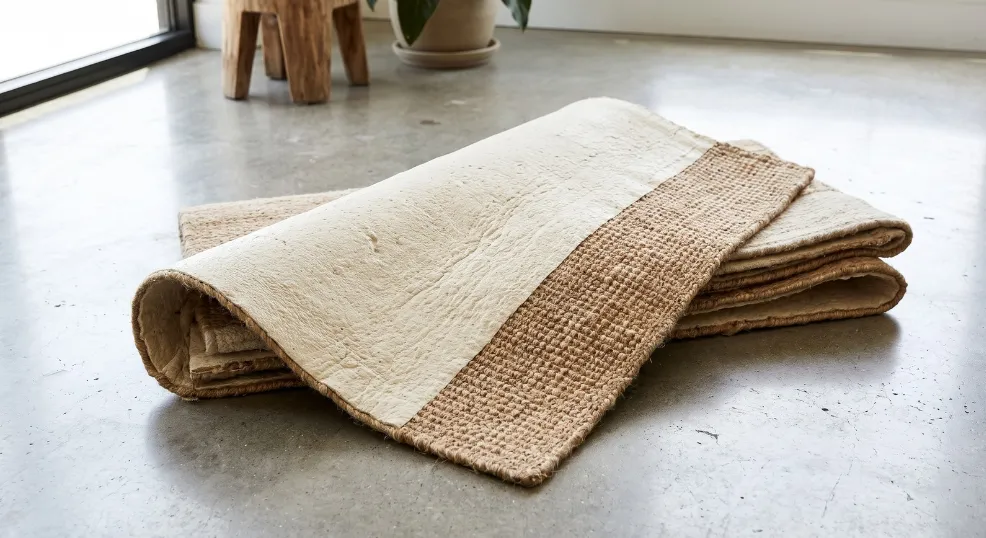
Marketing teams love the word natural, but flipping your rug over often reveals a different story. Synthetic latex adhesives, PVC backings, and mystery bonding agents are the primary sources of indoor air pollution in these products. A truly non-toxic rug will explicitly state that it features a jute, cotton, or natural latex backing with no added chemical treatments.
When Natural Materials Become a Hazard
Moisture is the ultimate enemy of almost every plant-based home textile. In bathrooms, basements, or coastal climates above 50% relative humidity, these absorbent fibers shrink, warp, and incubate mold within weeks. This is not a manufacturing defect, but rather a biological reality of bringing dried plants into damp indoor environments.
Even premium wool requires prompt drying after major spills to prevent mildew from forming in the backing layer. If you live in a highly humid area or have pets prone to accidents, you are better off skipping natural fibers entirely. High-quality synthetic rugs with recycled content offer much better spill management and can easily be hosed off outside.
Debunking the Hypoallergenic Myth
Many buyers falsely assume that any natural fiber automatically prevents allergies and asthma. The truth is that any floor covering becomes a massive dust reservoir if you ignore basic cleaning and humidity control. While wool actively traps airborne allergens better than loose-weave jute, an unvacuumed rug will always trigger respiratory sensitivities.
Fire safety is another area where misinformation runs rampant among home decorators. People assume dried grasses are fire hazards, but jute, sisal, seagrass, and wool all possess inherently low flammability. They smolder and char rather than melting into toxic puddles, making them perfectly safe near hearths if you maintain a standard 3-foot (90 cm) clearance.
The Real Cost of Natural Rugs Over a Decade
That cheap jute rug might end up costing you an absolute fortune over its actual lifespan. Replacing a budget piece every five years in a busy living room means buying three rugs over the lifespan of one premium alternative. Add in the frustration of permanent stains, and the cheap option quickly becomes an expensive mistake.
Amortized over a few decades, wool often costs significantly less per year than repeatedly replacing damaged plant fibers. If wool stretches your budget too far, seagrass bridges the gap perfectly with an impressive ten-year lifespan. It offers the absolute smartest middle ground for families wanting an organic aesthetic without the intense maintenance headaches.
The Final Verdict on Natural Fiber Safety
Natural decor delivers on its safety and eco-promises only when matched correctly to your home environment. Wool easily earns its reputation as the healthiest, most durable option for long-term investments. Seagrass offers unbeatable plant-fiber performance in spill-prone zones, while jute and sisal remain beautiful additions to dry, quiet rooms.
The real danger never lies in the fiber itself, but rather in a stubborn mismatch with your daily lifestyle. Reading labels, managing indoor moisture, and investing in untreated materials will keep your indoor air clean and your floors looking gorgeous. Choose wisely, vacuum often, and enjoy the earthy warmth these beautiful materials bring to your space.