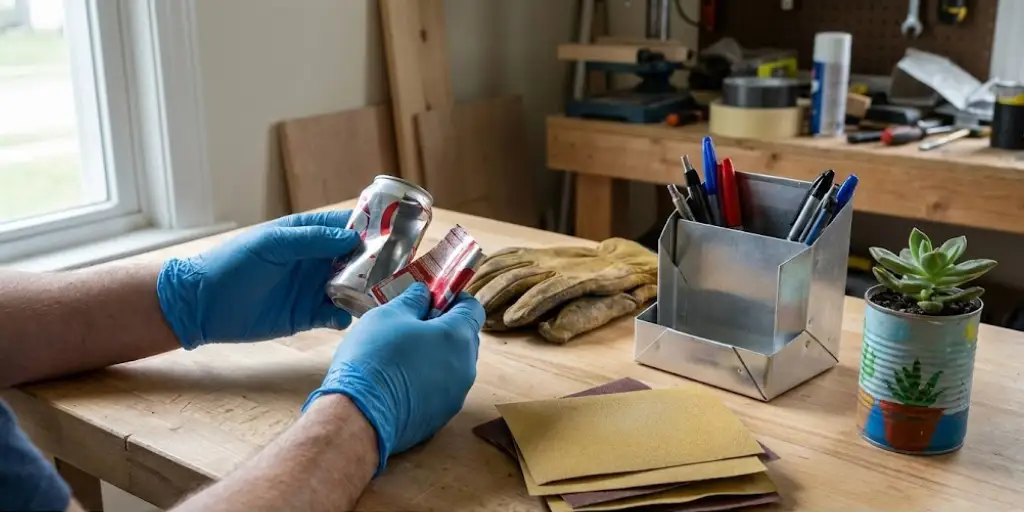
The Problem: You’ve seen hundreds of Pinterest boards showing stunning upcycled aluminum can projects—lanterns, planters, jewelry, kids’ toys—and the promise that these materials are “infinitely recyclable” makes them feel like the ultimate eco-craft supply. But can you truly reuse the same physical can over and over? And is it actually safe for your family, especially when kids are involved?
The Promise: This guide cuts through the recycling industry jargon to reveal what “infinite recyclability” really means for home crafters, exposes the hidden safety boundaries of beverage can reuse, and gives you science-backed rules for when aluminum crafts are brilliant—and when you should reach for safer alternatives.
Why “Infinitely Recyclable” Doesn’t Mean “Forever Reusable”
Industrial vs. Home Reality. When manufacturers say aluminum cans are infinitely recyclable, they’re describing the metal’s ability to be melted down and reformed into new products without losing core properties. In recycling facilities, your crushed can returns to the shelf as a fresh beverage container in roughly two months, often with over 90% recycled content.
The Craft Workshop Truth. That same can in your craft room faces completely different physics. The ultra-thin walls (typically 3004 or 3104 aluminum alloy at around 0.1mm thickness) are engineered for a single lifecycle: manufacture, fill, drink, recycle. Here’s what happens when you try to extend that lifecycle at home:
- Work-Hardening Accelerates. Each bend, cut, or fold makes the metal progressively more brittle through micro-structural changes, eventually leading to unexpected cracks or sharp fractures
- Protective Coatings Degrade. The internal polymer linings and external inks weren’t designed for sanding, repeated handling, or outdoor exposure—they’ll chip, peel, and expose bare metal
- Edge Multiplication. Every craft session creates new cut edges that oxidize and roughen over time, multiplying injury risk
Verdict: You can safely reuse aluminum cans multiple times for decorative projects with proper edge treatment, but the physical can itself has a craft lifespan measured in 3-8 transformations, not infinite iterations.
The Hidden Chemistry: What’s Actually Inside Your Can
Multi-Layer Engineering. Modern beverage cans aren’t just aluminum—they’re sophisticated packaging systems with at least three distinct material layers working together.
Interior Polymer Linings. Every can carries a microscopic coating (5-20 microns) on its inside surface to prevent metal corrosion and flavor contamination:
- Historical Formula: BPA-based epoxy resins, now largely phased out due to endocrine disruption concerns
- Current Standard: BPA-NI (BPA-not-intentionally-added) systems using advanced acrylics, polyesters, or olefin blends
- Critical Limitation: These linings are validated for single-use food contact under controlled temperature and duration—not for repeated craft manipulation, heating, or long-term soil contact in planters
External Inks and Clearcoats. The vibrant graphics you see are locked under UV-resistant clearcoats designed for warehouse storage and retail display, not for:
- Prolonged skin contact during crafting sessions
- Sanding or abrasive shaping that exposes pigment layers
- Outdoor UV exposure in garden projects (leads to chalking and flaking)
Bare Alloy Exposure Risk. When you cut or heavily scratch the can, you breach both protective layers, exposing 3xxx-series aluminum that will naturally oxidize (forming a dull gray patina) and become rougher with moisture exposure.
Safety Boundaries: When Aluminum Crafts Cross the Line
The Golden Rule Matrix. Use this decision framework for every aluminum can project:
| Craft Category | Safety Status | Required Precautions |
|---|---|---|
| Decorative storage (pens, brushes, dry goods) | Safe | De-burr all edges, seal with low-VOC topcoat |
| Planters (succulents, herbs) | Conditional | Drainage holes only, no edible roots touching can walls, outdoor UV degrades faster |
| Jewelry & wearables | Conditional | Sand all edges to 220+ grit, apply clear enamel barrier, inspect regularly for sharp points |
| Kids’ crafts (toys, wearables) | High Risk | Sharp edge potential + coating unknowns + mouthing risk = choose paper/wood alternatives |
| Food contact reuse (cookie cutters, containers) | Prohibited | Degraded linings + contamination history + no safety validation = hard no |
Edge Management is Non-Negotiable. The single biggest safety issue with aluminum can crafts isn’t toxicity—it’s laceration risk:
- Fresh Cuts: Beverage can aluminum is thinner than household foil when unrolled; cutting creates razor-sharp edges
- Work-Hardening Effect: After 2-3 bending cycles, the metal becomes brittle enough to fracture into unexpected points
- Treatment Protocol: Sand every cut edge to at least 220-grit smoothness, then seal with enamel or epoxy to prevent re-sharpening through oxidation
The Child Safety Exception. While aluminum alloy itself isn’t acutely toxic to touch, modern toy safety standards (ASTM F963, EN 71) have strict limits on:
- Heavy metal migration from coatings (lead, cadmium in vintage inks)
- Sharp point accessibility (detailed probe tests)
- Small part hazards (thin metal tears into choke-risk fragments)
Beverage cans were never tested to these standards, making them unsuitable for mouthable items or unsupervised kids’ projects.
Smarter Alternatives: When to Choose Other Materials
Recycled Paperboard for Kid-Safe Crafts. FSC-certified or post-consumer kraft card offers similar upcycling satisfaction with critical advantages:
- No Sharp Edges. Scissors create clean, soft cuts that won’t lacerate fingers
- Verified Safe Coatings. Look for brands using EN 71-compliant, low-VOC water-based inks and adhesives
- True Compostability. Many paperboards biodegrade in 60-90 days when free of plastic lamination, closing the loop aluminum can’t match
- Repeat Manipulation. Cardboard tolerates folding, gluing, and painting cycles without brittleness
Steel Cans for Structural Durability. Food-grade steel cans (tomato, soup, coffee) bring different strengths:
- Thicker Gauge. Walls measure 0.2-0.3mm vs. aluminum’s 0.1mm, resisting dents and maintaining rigidity
- Magnetic Separation. Just as recyclable as aluminum (often exceeding 80% recovery rates in the EU) with easier sorting
- Better for Load-Bearing. Ideal for tool organizers, tiered planters, or workshop storage that aluminum’s thin walls can’t support
- Trade-Off: Heavier weight and potential rust if protective coatings are breached
Pairing Strategy: Use aluminum for lightweight decorative pieces (luminaries, wall art, desk accessories), paperboard for children’s creative projects, and steel for functional storage that needs durability.
The Eco-Impact Reality Check
Recycling vs. Reusing: Which Wins? The environmental math gets complicated when you compare home craft reuse against industrial recycling.
Aluminum Recycling Saves 95% Energy. Melting and reforming aluminum consumes only 5% of the energy needed to produce virgin metal from bauxite ore—one of manufacturing’s most dramatic efficiency gains. A can recycled through municipal systems delivers maximum environmental benefit.
Home Reuse Extends Lifespan. Every craft project that delays (or prevents) recycling keeps the can out of the waste stream a bit longer, but the energy savings are indirect:
- Positive: Reduces demand for new organizational products or décor items
- Neutral: If your craft uses additional materials (paint, sealants, adhesives), you’ve added embodied energy and potential disposal complexity
- Negative: If the finished craft eventually breaks and becomes un-recyclable (mixed materials, contaminated with soil/adhesive), you’ve converted a high-value recyclable into landfill waste
The Verdict for Eco-Conscious Crafters. Aluminum can crafts make environmental sense when:
- You’re replacing a purchase (handmade planter vs. buying plastic pot)
- The project uses minimal additional materials
- You plan careful end-of-life (disassemble to recycle aluminum, compost paper elements)
- You’re genuinely filling a functional need, not accumulating craft clutter
For projects that fail these tests, simply recycling the can delivers better planetary outcomes.
Looking for Safe Project Ideas?
Now that you know the safety rules, put them to good use! Check out our collection of 15 Genius Tin Can Storage Hacks to help declutter your small space responsibly.
Key Takeaways: The Craft Reuse Rulebook
Material Truth. Aluminum beverage cans use a 3004/3104 alloy designed for deep drawing and single-use packaging, not repeated home manipulation. The metal itself doesn’t degrade, but coatings, edges, and mechanical fatigue impose real limits.
Safety Framework. Acceptable for decorative, non-food, non-mouthable crafts when edges are thoroughly de-burred and surfaces are sealed. Never appropriate for children’s toys, food contact, or anything that might go in a mouth.
Coating Awareness. Modern BPA-NI linings reduce one specific risk but remain complex polymer systems validated only for original packaging use. Cutting, sanding, or heating can compromise their integrity in unknown ways.
Lifespan Expectation. Plan for 3-8 transformation cycles before work-hardening, coating degradation, or edge condition forces retirement. This is “multi-use,” not “infinite use.”
Best Applications. Desk organizers, wall-mounted planters (with drainage consideration), luminaries, decorative garlands, embossed art panels—projects that showcase aluminum’s lightweight shimmer without demanding structural durability.
When to Choose Alternatives. Kids’ crafts, wearable items with prolonged skin contact, food storage, or any application where safety certification matters—reach for paperboard, certified craft metals, or purpose-made supplies.
The Bottom Line: Aluminum cans are brilliant upcycling materials for the right projects, but “infinitely recyclable” is an industrial promise, not a home craft reality. Treat them as multi-use resources with safety boundaries, not magic forever-materials, and your projects will be both creative and responsible.
Still wondering which material suits your next project? Explore our Eco-Friendly Craft Supplies category for deep dives into sustainable alternatives—from reclaimed wood basics to plant-based adhesive guides—that match your safety standards and creative ambitions.